Here’s Why AI Answer Eligibility Matters More Than Indexing
AI SEO requires new strategies. Learn how to build content that AI models trust, improve answer eligibility, and future proof your organic growth as discovery shifts from blue links to AI outputs.
Written by
AI search
Dec 12, 2025

Indexation is a binary but eligibility is a spectrum.
Indexation is simple. A page is either in or out. You can fix that with technical hygiene.
AI answer eligibility is dynamic. It changes per query. The model decides if your content is helpful, structured, trustworthy, and comprehensive enough to support an answer. That evaluation happens in real time.
Eligibility depends on factors like:
Strength of your topical depth
How clearly your content is structured
Whether your answer aligns with the intent behind a complex query
How well you cover scenarios, constraints, and what-if conditions
How consistent you are across a topic cluster
A perfectly optimized site can still be invisible inside AI outputs. Meanwhile, a smaller site with strong semantic authority and deeply structured content can outperform big brands in AI citations.
This is the new frontier. SEOs must shift attention from the index to the model.
AI does not “search” like a human. It evaluates like a teacher.
Search engines crawl and rank. AI systems interpret and assemble.
An AI model does not inspect ten blue links. It identifies the most useful information that can help it form a single, coherent answer. Models evaluate content almost like a teacher grading an exam. They look for clear definitions, logical structure, reasoning, and supporting context.
This is the opposite of traditional SEO tactics. It requires content that is structured for reasoning, not rankings.
Three principles now define AI answer eligibility:
1. Knowledge structure matters more than keyword density.
Models rely on connected ideas and clean logic. Comparison tables, definitions, decision trees, frameworks, and step-by-step sequences outperform keyword-stuffed paragraphs.
2. Comprehensive beats concise.
AI prefers pages that cover the entire problem space. Not just the core topic but scenarios, constraints, audience variations, and common follow-up questions. Your content becomes a knowledge base, not a snippet.
3. Real expertise wins over surface-level summaries.
Models look for reasoning. Pages that explain tradeoffs, frameworks, and decision criteria are far more referenceable than generic “top ten” articles.
This is why AEO, or AI Experience Optimization, is becoming a core SEO discipline. It is not about ranking signals. It is about shaping how a model thinks about your content.
Why traditional SEO metrics will mislead you in 2025
Most teams still track indexation, impressions, clicks, and rankings as their primary indicators. These signals will not disappear, but they no longer represent the whole picture.
You can lose traffic while gaining AI visibility. You can drop rankings but increase citations inside AI outputs.
This is the fragmentation era of search. Expect to see:
Search volume that no longer reflects true demand
CTR that swings unpredictably
Personalised rankings that differ widely
AI summaries that act as the new position zero
The new north star is AI referenceability.
Some emerging indicators to monitor:
How often your content appears in AI generated summaries
How many intent variations your content is eligible for
Depth and coherence of your topic clusters
Machine readability across your core pages
Volume of structured knowledge versus narrative text
The companies that optimise for the model layer will win the next decade of organic visibility.
The new SEO playbook: Optimize for AI eligibility
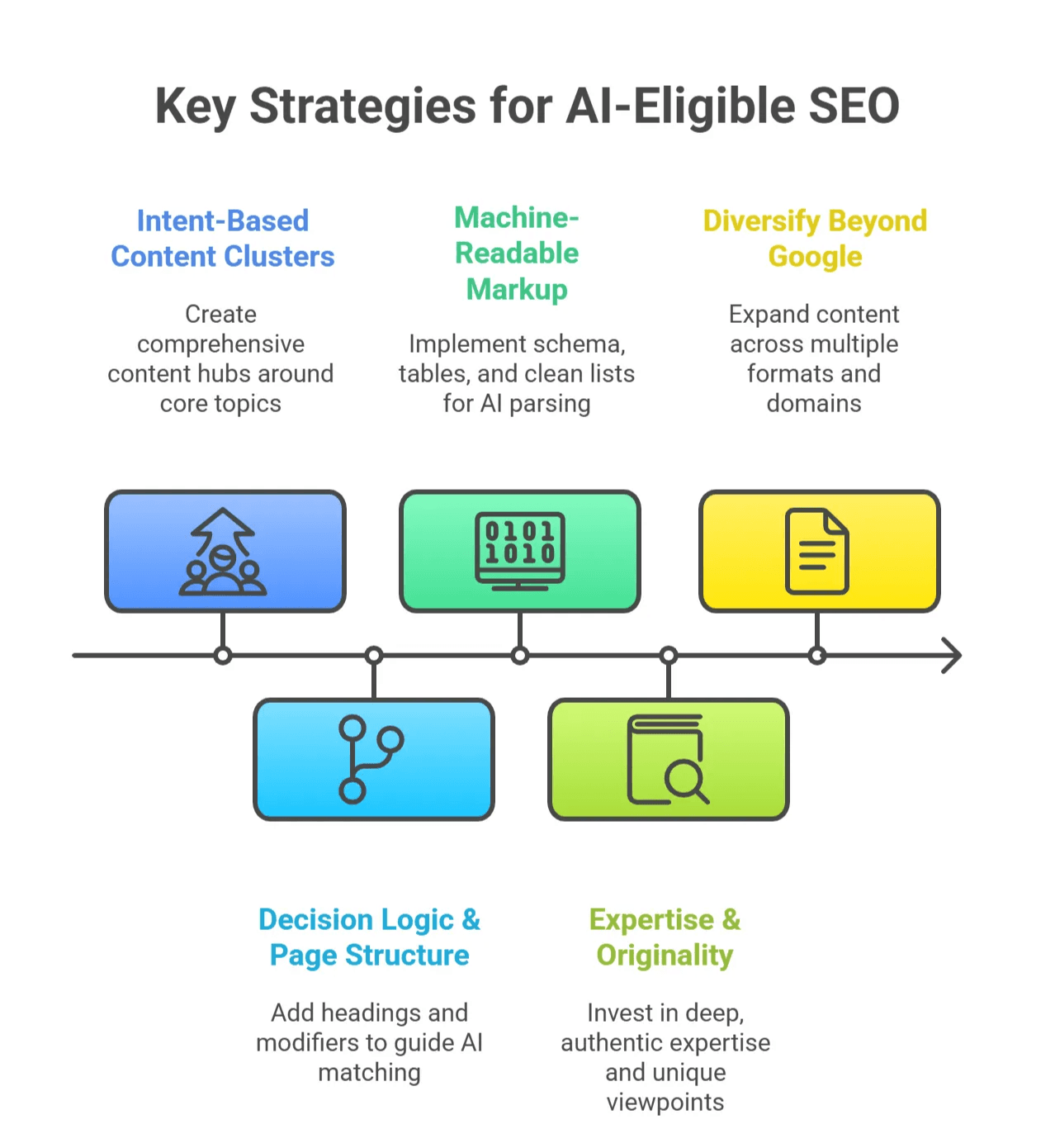
1. Build content for intent clusters, not single keywords
Get deep on a topic. Every core topic should have:
A definition
A how-to
Templates
Comparisons
Scenario-based guidance
Common mistakes
Follow-up questions
This allows the model to treat your site as an authoritative knowledge graph.
2. Add decision logic and structure to every page
Use headings like:
“If you have a small budget”
“If you are a mid market team”
“If you need this for Europe”
“If you are comparing X vs Y”
These modifiers help AI match your page to conversational queries.
3. Make your site machine readable
Think in terms of markup, schema, tables, explicit definitions, and clean lists. Each of these gives the model more confidence in your content.
4. Invest in true expertise
The model rewards reasoning. Real experience. Contrarian viewpoints. Depth. You cannot fake this with generic content or rewriting the top three SERP results.
5. Diversify beyond Google
AI agents will pull from all sources. Blogs. PDFs. Product pages. Knowledge bases. Clustered content across a domain. Your job is to make that domain the strongest possible source of truth.
Wrapping up: Indexation is no longer the North Star
Most sites will be indexed. That is the baseline.
The real future of SEO is about becoming a reliable source for AI-generated answers. A new economy of visibility is emerging. It is not about ranking. It is about citation and synthesis. It is about earning trust from a model that is designed to solve problems, not return blue links.
The shift has already started. Teams that adapt now will become the new authorities in their categories.
Similar Blogs


Get found in AI search
Ready to start?